Why Does Business Credibility Matter More Than Visibility?

What Does Credibility Mean in Business?
Credibility is the trust stakeholders place in an organization, its leaders and its communications. It is what helps people believe your message, respect your expertise and choose you with confidence.
Why Does Credibility Matter More Than Visibility?
Visibility gets attention. Credibility earns trust. Organizations that communicate clearly, act consistently and show real expertise are more likely to attract customers, employees, partners and investors.
What Is the Direct Answer?
Credibility matters more than visibility because people are not just looking for information. They are deciding who deserves their trust. Awareness may open the door, but credibility is what moves people to act.
Who Is This For?
This article is designed for:
CEOs
Business owners
C-suite executives
Marketing leaders
Communications professionals
Franchise organizations
Professional service firms
Organizations focused on long-term growth
Why Does This Topic Matter?
There was a time when visibility felt like the primary goal. Organizations wanted more media coverage, more speaking opportunities, more social engagement and more content. Visibility was often treated as the ultimate measure of success.
Today, that is no longer enough.
Stakeholders can find information about almost any company within seconds. What matters now is whether that information builds confidence. Organizations that focus solely on awareness often find that recognition without trust creates little business value.
What Is Business Credibility?
Business credibility is the trust stakeholders place in an organization based on its actions, communications, leadership and reputation.
Credibility is built through:
Transparent leadership
Demonstrated expertise
Positive stakeholder experiences
Industry recognition
Reliable business performance
Positive business reviews
Unlike visibility, credibility cannot be purchased. It must be earned over time.
Why Is Visibility Alone No Longer Enough?
Modern audiences are overwhelmed with information. Every day, they are exposed to countless messages competing for their attention.
As a result, the question stakeholders ask has changed.
It is no longer: "Can I find information about this organization?"
It is: "Can I trust what I find?"
That distinction changes everything.
Visibility may create awareness, but credibility determines whether someone becomes a customer, employee, investor or business partner.
Visibility vs. Credibility
| Visibility | Credibility |
|---|---|
| Creates awareness | Creates trust |
| Generates attention | Influences decisions |
| Helps people discover you | Helps people choose you |
| Can be purchased through promotion | Must be earned over time |
| Produces short-term exposure | Produces long-term influence |
| Attracts audiences | Retains stakeholders |
Organizations need both. However, credibility is what transforms awareness into action.
The Credibility Alignment Framework™
Organizations can evaluate credibility using five key areas:
| Credibility Driver | Key Question |
|---|---|
| Messaging Consistency | Does every channel tell the same story? |
| Leadership Visibility | Are leaders communicating expertise and values? |
| Third-Party Validation | Do respected sources support your claims? |
| Stakeholder Experience | Do actions align with messaging? |
| Reputation Management | Is trust being built continuously? |
When all five areas align, organizations achieve greater influence and resilience.
How Does Inconsistency Damage Credibility?
One of the most common challenges organizations face is inconsistency.
The website tells one story.
Leadership communicates another.
Social media emphasizes different priorities.
Media coverage presents yet another perspective.
Each inconsistency may seem minor on its own. Together, they create uncertainty.
Stakeholders begin asking:
What does this organization stand for?
What makes it different?
Can its claims be trusted?
In a marketplace where attention is limited, uncertainty often sends people elsewhere.
Why Is Reputation a Strategic Business Asset?
Reputation influences far more than public perception.
It affects:
Client acquisition
Employee recruitment
Investor confidence
Strategic partnerships
Customer retention
Crisis resilience
Long before stakeholders make decisions, they are already forming opinions based on the information and experiences available to them.
The strongest organizations understand that reputation is not something they build when they need it. It is something they invest in continuously.
What Role Does Leadership Play in Building Credibility?
Increasingly, stakeholders want to hear directly from leaders.
They want:
Insight
Perspective
Expertise
Transparency
Evidence of values in action
When executives participate thoughtfully in industry conversations, contribute meaningful perspectives and communicate with clarity, they strengthen both their own credibility and the credibility of the organizations they represent.
Leadership visibility works best when it demonstrates expertise rather than self-promotion.
Why Must Communications Support Business Strategy?
Many organizations view communications as a collection of separate tactics:
Press releases
Speaking engagements
Bylined articles
Social media campaigns
Media interviews
Podcast appearances
Each tactic can be valuable.
The problem occurs when those activities operate independently rather than supporting a larger strategy.
We often summarize successful communications with three words: Simple. Strategic. Sustainable.
The most effective communications programs reinforce a consistent narrative about who an organization is, what it stands for and where it is headed
Why Does Credibility Matter During Difficult Times?
Organizations that build trust before challenges arise are often better positioned to navigate uncertainty.
Stakeholders give trusted organizations more benefit of the doubt.
This creates what communications professionals often call a reputation reserve.
When challenges emerge, organizations with established credibility have a foundation of goodwill to draw from. Those that focused primarily on visibility may discover that recognition alone offers little protection when difficult questions arise.
Trust becomes a business asset long before it is tested.
How Can Organizations Build Credibility?
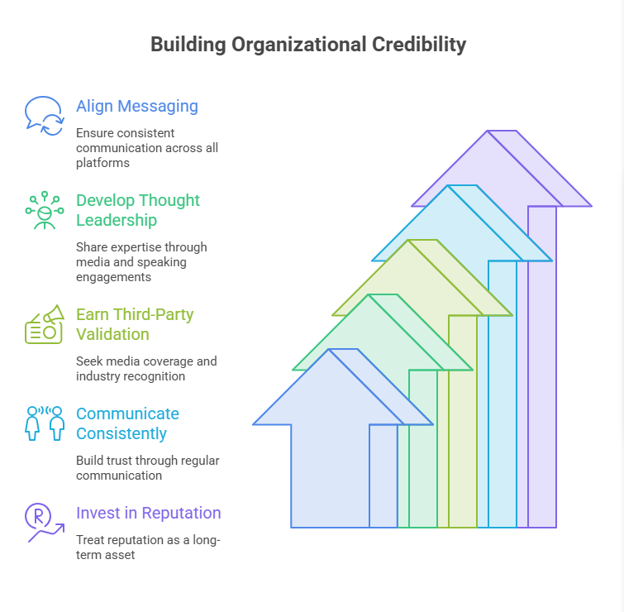
Step 1: Align Your Messaging
Ensure your website, leadership communications, marketing materials and media presence tell the same story.
Step 2: Develop Thought Leadership
Create opportunities for leaders to share expertise through media interviews, speaking engagements and contributed content.
Step 3: Earn Third-Party Validation
Seek media coverage, awards, testimonials and industry recognition that reinforce credibility.
Step 4: Communicate Consistently
Build trust through regular communication rather than occasional bursts of visibility.
Step 5: Invest in Reputation Continuously
Treat reputation as a long-term business asset rather than a short-term campaign.
Common Mistakes Organizations Make
Focusing on awareness instead of trust
Treating communications as disconnected tactics
Allowing inconsistent messaging across channels
Neglecting executive visibility
Reacting to reputation issues instead of proactively managing them
Assuming visibility automatically creates credibility
How Should Organizations Measure Credibility?
| Metric | Why It Matters |
|---|---|
| Media quality | Measures authority of coverage |
| Executive visibility | Tracks leadership influence |
| Brand sentiment | Evaluates public perception |
| Stakeholder trust surveys | Measures confidence levels |
| Referral business | Indicates trust-driven growth |
| Employee retention | Reflects internal credibility |
| Partnership opportunities | Signals market confidence |
Frequently Asked Questions
What is the difference between visibility and credibility?
Visibility helps people find your organization. Credibility helps people trust your organization. Visibility creates awareness while credibility influences decisions.
Can an organization be highly visible but lack credibility?
Yes. Some organizations generate significant attention but fail to earn stakeholder trust. High visibility without credibility often produces awareness without meaningful influence.
Why is credibility important for business growth?
Credibility strengthens customer relationships, supports recruiting efforts, attracts partners and improves stakeholder confidence. Trust often accelerates business growth more effectively than awareness alone.
How do leaders contribute to organizational credibility?
Leaders demonstrate expertise, communicate values and provide transparency. Their actions and communications often shape stakeholder perceptions of the entire organization.
Why is reputation management important?
Reputation influences how stakeholders perceive an organization before making decisions. Strong reputations create resilience, opportunity and competitive advantage.
What Matters Most
Visibility may create awareness, but credibility is what transforms attention into trust, influence and long-term business success.
Ready to Build Greater Credibility?
If your organization wants to strengthen trust with customers, employees, investors and partners, start by aligning your communications, leadership visibility and reputation strategy. A strong reputation is not built through isolated tactics. It is built through consistent actions, authentic communication and a commitment to earning trust over time.

About the Author
Allison Hawk
Allison Hawk is a strategic communications leader and entrepreneur with more than two decades of experience across the public sector, professional sports, philanthropy and corporate communications. As founder of AHC Consulting, she helps organizations navigate complex community landscapes through authentic storytelling, stakeholder engagement and purpose-driven strategy. A former executive with the St. Louis Rams and FleishmanHillard, Allison has led award-winning campaigns, major civic initiatives and community partnerships that move people to action. She is a founding member of The Public Relations Collective, a graduate of Trinity University, a former Coro Fellow and a recipient of multiple PRSA Silver Anvil Awards.