
What Should Leaders Fix in Their AI Search Visibility Strategy?

AI search results are becoming the new first impression for most searchers. Buyers, journalists, analysts, investors and potential partners may ask ChatGPT, Gemini, Perplexity or Google’s AI features about your company before they visit your website or talk to your team.
That means your public information and your content have a new job.
It must be clear enough for people to trust and structured enough for AI systems to understand. If your company’s website says one thing, your press coverage says another, your executive bio is outdated and your service pages sound like they were written by committee, AI tools may summarize your brand poorly. Or worse, they may leave you out entirely.
That is not an AI problem. That is a communications problem.
An AI search visibility strategy helps leaders strengthen the facts, sources and signals AI tools use when summarizing their company. It connects public relations, content, earned media, search visibility, reputation signals, executive authority and technical structure into one clear system.
The work is not about tricking AI. The work is about making your company easier to understand, easier to verify and harder to misrepresent.
AI Search Visibility Strategy Definition
An AI search visibility strategy is a communications plan that helps AI-powered search tools accurately identify, understand, summarize, and cite a company.
It includes the public facts about your company, the clarity of your website, the strength of your earned media, the consistency of your brand language, the credibility of third-party sources, the structure of your content, and the technical access search engines and AI crawlers need.
A strong AI search visibility strategy answers these questions:
Who is the company?
What does the company do?
Who does it serve?
What problems does it solve?
Why is it credible?
What outside sources confirm that credibility?
Can AI tools find, understand and quote the information accurately?
If the answer is fuzzy, the strategy needs work.
What Leaders Need to Know First
An AI search visibility strategy helps leaders improve how their company appears in AI-generated answers. It does this by strengthening brand clarity, source consistency, earned media authority, expert content, schema, technical SEO and ongoing monitoring.
Don’t get me wrong, traditional SEO still matters. Digital PR services still matter. Website content still matters. The shift is that all of those channels now feed the larger AI discovery environment.
In plain English, AI tools are reading the room. Your job is to make sure the room contains accurate facts.
Who This Article Is For
This article is for leaders who have noticed that search behavior has changed, but have not yet adjusted their communications strategy.
It is especially useful for:
CEOs who care how their company is described online
Founders who need stronger visibility in their category
CMOs trying to connect PR, SEO and content strategy
Communications leaders managing brand reputation
Business owners who want buyers to find accurate information
Professional service firms competing on expertise
Franchise brands expanding into new markets
B2B companies with complex services
Healthcare, financial and nonprofit organizations where trust shapes decisions
This is not for companies looking for a quick trick. There is no magic prompt that fixes a weak brand signal. If the facts are scattered, vague or outdated, the work starts there.
Why AI Search Visibility Strategy Matters
Buyers are no longer moving in a neat line from Google search to website visit to sales call.
They ask questions. They compare options. They read summaries. They check reviews. They scan media coverage. They ask AI tools to explain who is credible, who offers the service and who appears to know what they are talking about.
That changes the job of public relations.
A company’s visibility is no longer shaped only by what it publishes on its own website. It is shaped by earned media, reviews, executive commentary, third-party mentions, directory profiles, social signals, FAQs, structured data and technical access.
If your company does not give AI tools a clear trail of credible information, those tools may rely on competitors or incomplete sources. That is how brands disappear from high-intent conversations before they even know they were considered.
Remember, AI does not owe your company a flattering summary. It works with what it can find online. If what it finds is weak, that is the signal you gave it.
What Is AI Search Visibility?
AI search visibility is how often and how accurately a company appears in AI-generated answers, summaries and recommendations.
It is not the same as ranking on page one of Google. It is not the same as getting a media hit. It is not the same as publishing a blog every week and hoping the internet gives you a gold star.
AI search visibility depends on a mix of signals:
Clear website content
Consistent brand language
Strong service pages
Earned media coverage
Executive thought leadership
Reviews and testimonials
Expert commentary
Industry sources
Schema markup
Technical SEO
AI crawler access
Ongoing content updates
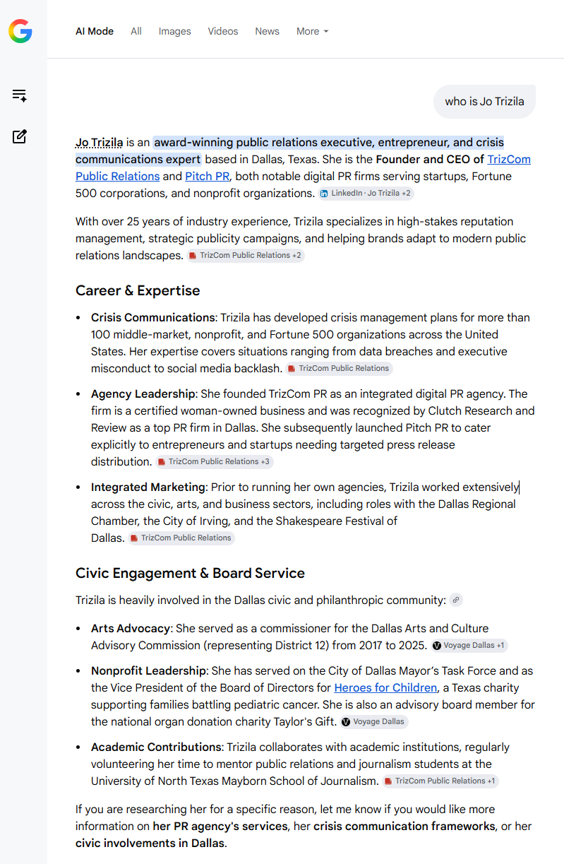
The goal is not just to appear. The goal is to be described accurately, consistently and credibly. Take for example the search below. I typed in “who is Jo Trizila.” Thankfully, everything is accurate. NOTE: if you haven’t done this on yourself and your company yet, stop what you are doing and do it.
How Is AI PR Different From Traditional PR?
Traditional PR, as we know it, has traditionally focused on media coverage, reputation, relationships and awareness.
AI PR still includes those things, but it adds another layer. It asks whether the company’s public signals are strong enough for AI platforms to recognize, trust and cite.
| Traditional PR | AI PR |
|---|---|
| Earned media placements | Earned media plus AI citation visibility |
| Brand awareness | Brand interpretation in AI answers |
| Media impressions | Inclusion in AI-generated summaries |
| Reputation management | AI narrative monitoring |
| Press coverage | Authority signals across trusted sources |
| Executive visibility | Expert signals that support AI summaries |
| Campaign reports | AI visibility diagnostics and narrative tracking |
The best AI PR services do not abandon traditional public relations. They make PR more accountable to how people actually discover and evaluate companies now.
Why Traditional SEO Alone Is Not Enough
Again, SEO still matters. Anyone saying SEO is dead is usually selling something loud.
Google has made clear that foundational SEO remains relevant for generative AI features in Google Search. Pages still need technical access, indexability and useful content. That said, AI search visibility expands the field.
Traditional SEO often focuses on rankings, keywords, page structure and organic traffic. AI search visibility also looks at entity understanding, authority signals, citation patterns and how answers are formed across multiple sources.
| Traditional SEO focus | AI search visibility focus |
|---|---|
| Ranking for keywords | Being understood as an entity |
| Driving clicks | Being included in AI-generated answers |
| Meta titles and headings | Clear facts, proof and source consistency |
| Backlinks | Authority signals from credible third-party sources |
| Blog volume | Answer quality and citation readiness |
| Search impressions | AI mentions, accuracy and competitor presence |
| Website optimization | Owned, earned, shared and third-party signal alignment |
A company can rank in traditional search and still be weak in AI answers. That is the part leaders need to stop brushing off.
For brands trying to connect SEO, PR and AI discovery, generative search optimization is where the conversation is headed.
What Leaders Need to Fix First
Is Your Company Name Consistent Everywhere?
Start here, because this is where many brands quietly sabotage themselves.
If your company appears as TrizCom PR in one place, Triz Com in another, Trizila Communications in a profile and TCPR in a media mention, AI tools may not connect the dots cleanly.
That creates an entity problem.
Leaders should audit:
Website header and footer
About page
Google Business Profile
LinkedIn company page
Press releases
Media coverage
Award listings
Speaker bios
Podcast bios
Industry directories
Review platforms
Author bios
Case studies
Your brand name is not a creative writing exercise. Pick the official version and use it until everyone is bored. That boredom is consistently doing its job.
Does Your Website Explain What You Do in Plain Language?
Vague website copy is one of the fastest ways to weaken AI search visibility.
If your homepage says you “empower innovative transformation,” congratulations. You have said almost nothing.
AI tools need clear language. So do humans.
Weak copy
We create integrated solutions for modern growth.
Stronger copy
TrizCom PR helps companies improve visibility, credibility and brand authority through public relations, media relations, content strategy, reputation management and AI search visibility planning.
Website copy should answer:
What do you do?
Who do you serve?
What problem do you solve?
Where do you operate?
What services do you offer?
What proof supports your claims?
Who leads the company?
What should someone do next?
Are Your Leaders Visible as Expert Sources?
AI search visibility is not only about the company. It is also about the people connected to the company.
Executives, founders and subject matter experts can strengthen brand authority when their expertise appears in credible places.
Useful visibility signals include:
Executive bios
Media quotes
Bylined articles
Podcast interviews
Speaking engagements
LinkedIn thought leadership
Trade publication commentary
Webinar appearances
Event bios
Award profiles
An invisible executive cannot complain when AI tools do not recognize their expertise. Visibility has to be built before it is needed.
This is where strategic media relations and executive positioning need to work together.
Do You Have Enough Third-Party Proof?
Your website matters, but it should not be the only place your credibility lives.
AI tools may draw from a mix of owned content and third-party sources. That means public relations has a direct role in AI-era visibility.
Third-party proof can include:
Earned media coverage
Trade publication mentions
Analyst references
Podcast interviews
Awards
Speaking engagements
Reviews
Testimonials
Partner pages
Industry profiles
Case studies
Expert roundups
Press releases
This is where PR earns its place at the strategy table. Media relations, expert positioning and credible content can create public proof that owned content (aka your website) alone cannot deliver.
It also ties directly to reputation management (think Yelp, Reddit, etc.), because AI summaries can shape perception before a buyer ever clicks a link.
Are Your Service Pages Built Around Real Questions?
Most service pages are too thin. They list services, add a few polished claims and then end with “contact us.”
That is not enough anymore.
Service pages need to answer the questions buyers ask and AI tools summarize.
For any service page, useful sections include:
What is this service?
Why does this service matter?
Who needs this service?
What problems does this service help solve?
How does this service support broader business goals?
How does this service work with related marketing, communications or visibility efforts?
What proof points, examples or results help show its value?
What should leaders understand before investing in this service?
How can a company measure whether this service is working?
How often should the strategy, content or performance be reviewed?
Can AI Tools Access and Understand Your Website?
This does not need to become technical soup. But the basics matter.
Leaders should ask whether their team has checked:
Indexable pages
Clean URLs
Clear title tags
One H1 per page
Question-based H2s and H3s
Descriptive internal links
XML sitemap
Robots.txt settings
Schema markup
Mobile performance
Descriptive image alt text
Updated publish dates
Clear author bios
OpenAI and Perplexity both publish crawler guidance that site owners can review. Google also provides guidance on generative AI features and structured data.
The CLEAR AI Search Visibility Framework
The CLEAR framework gives leaders a simple way to audit AI search visibility without turning the work into a 90-page report nobody reads.
| Step | What it means | What to check |
|---|---|---|
| C | Consistency | Company name, services, leadership, locations and descriptions match across public sources |
| L | Language | Website copy explains what the company does in direct, specific terms |
| E | Evidence | Earned media, reviews, case studies, awards and expert content support brand claims |
| A | Access | Search engines and AI crawlers can reach and interpret important pages |
| R | Review | AI answers are tested regularly and content is updated when gaps appear |
C Means Consistency
AI tools need repeated, matching signals. If every profile describes the company differently, you are making the machine work too hard.
L Means Language
Plain language is not dumbing down. It is discipline. If a buyer cannot understand the copy quickly, AI tools may struggle too.
E Means Evidence
Proof matters. Earned media, expert commentary, awards, reviews and credible sources help reinforce the company’s authority.
A Means Access
If your pages are blocked, broken, buried or poorly structured, the strategy has a hole in it.
R Means Review
AI search visibility changes. Competitors publish. Platforms update. Sources shift. A one-time audit is not a strategy.
How Can Leaders Start Building an AI Search Visibility Strategy?
Step 1 Audit How AI Tools Describe Your Company
Test prompts across ChatGPT, Gemini, Perplexity and Google’s AI features.
Sample prompts:
What does [company name] do?
Is [company name] credible?
Who leads [company name]?
What services does [company name] offer?
What companies provide [service category] in [market]?
Compare [company name] with competitors.
What is [company name] known for?
Track what appears, what is missing and what is wrong.
Step 2 Audit Your Entity Signals
Review your company’s public footprint.
Check:
Official company name
Founder name
Executive titles
Service names
Location
Phone number
Website URL
Brand descriptions
Awards
Industry categories
Author bios
Step 3 Rewrite Key Pages for Clarity
Prioritize the pages that shape first impressions.
Start with:
Homepage
About page
Service page
Bio page
Case studies
FAQ page
Strong content creation is not about publishing more words. It is about making the right facts easier to find, understand and trust.
Step 4 Build Source Signals Through PR
Owned content alone is not enough.
Build public proof through:
Podcast interviews
Speaking opportunities
Award submissions
Third-party profiles
Case studies
Review strategy
Thought leadership
This work belongs inside a broader public relations services plan, not in a random content calendar.
Step 5 Add Schema and Technical Support
Schema will not rescue weak content. It can help search engines better understand strong content.
Recommended schema:
Article schema
FAQPage schema
Person schema
Organization schema
BreadcrumbList schema
Service schema where appropriate
Step 6 Monitor and Refresh Every 90 to 180 Days
AI search visibility is not a set-it-and-forget-it project.
Track:
AI answer accuracy
Brand mentions
Citation sources
Competitor mentions
AI referral traffic
Organic impressions
Branded search growth
Earned media pickup
Lead quality
Conversion paths
This is where analytics and reporting need to expand beyond traditional PR metrics.
What Mistakes Hurt AI Search Visibility?
Mistake 1: Writing Content That Sounds Important but Says Nothing
If the copy is vague, AI tools have less to extract. “Trusted partner” is not a strategy. “Innovative solutions” is not a service description. Say what the company does.
Mistake 2: Treating AI Search as a Tech Problem Only
Technical SEO matters, but communications drives meaning. If the brand story is unclear, cleaner code will not save it.
Mistake 3: Ignoring Third-Party Mentions
Your website is not the entire source pool. PR matters because outside sources can strengthen credibility.
Mistake 4: Letting Old Bios and Profiles Sit Online
Old descriptions keep spreading. A dated executive bio can become the version AI tools use.
Mistake 5: Measuring Only Website Traffic
AI visibility can influence decisions before a click happens. Track mentions, summaries, citations and referral traffic along with traditional analytics.
What Technical Checks Should Happen Before Publishing?
Before publishing, confirm:
H1 appears once
Primary keyword appears in SEO title, meta tag, first 150 words and at least one H2
Definition appears near the top
AI answer summary appears near the top
Entity clarity box is included
CLEAR framework table is included
FAQs are visible on the page
Article schema is added
FAQPage schema is added
Person schema
Organization schema
Internal links point to related service pages
External citations support technical claims
Images include descriptive alt text
Publish date and review date are visible
Page is indexable
Page loads well on mobile
How Should Leaders Measure AI Search Visibility Strategy?
| Metric | Why it matters |
|---|---|
| AI answer accuracy | Shows whether platforms describe the company correctly |
| Brand citation frequency | Shows whether the brand appears in AI-generated answers |
| Competitor comparison mentions | Shows whether competitors are favored |
| AI referral traffic | Shows whether AI tools send visitors |
| Organic impressions | Shows whether search visibility is improving |
| Branded search volume | Shows whether awareness is increasing |
| Earned media pickup | Shows third-party authority growth |
| Content engagement | Shows whether answer-ready content is useful |
| Lead quality | Shows whether visibility reaches the right audience |
| Conversion rate | Shows whether visibility supports business outcomes |
Measurement belongs in the strategy from the start. If the team cannot explain how AI visibility is being tracked, the plan is not finished.
Frequently Asked Questions About AI Search Visibility Strategy
What is an AI search visibility strategy?
An AI search visibility strategy is a communications plan that helps AI tools understand, summarize and cite a company accurately. It connects public relations, website content, earned media, reviews, schema, technical SEO and ongoing monitoring.
How does PR help AI search visibility?
PR helps AI search visibility by building credible public signals through earned media, expert commentary, bylined articles, podcasts, awards and third-party mentions. These sources can help AI tools better understand what a company does and why it may be credible.
What is the difference between SEO and AI search visibility?
SEO helps content rank and attract traffic through search engines. AI search visibility helps a company appear accurately in AI-generated answers, summaries and recommendations.
Why does company name consistency matter in AI search?
Company name consistency helps AI tools connect mentions across websites, media coverage, directories, profiles and reviews. Inconsistent naming can weaken entity recognition and create confusion.
Can AI tools describe my company incorrectly?
Yes. AI tools can generate incomplete or inaccurate summaries when public information is thin, outdated, inconsistent or hard to verify. The answer is not panic. The answer is stronger public information.
Do earned media mentions affect AI search visibility?
Earned media can support AI search visibility when coverage is accurate, relevant and connected to the right company, leader or topic. Strong media mentions create third-party proof that owned content alone cannot provide.
How often should companies audit AI search visibility?
Companies should audit AI search visibility every 90 to 180 days. For fast-moving categories, major announcements, leadership changes or reputation issues, review more often.
What should leaders fix first?
Start with official company name, website clarity, executive bios, service descriptions, review profiles, earned media references and technical crawlability. Fancy tactics come later. Fix the foundation first.
The One Sentence That Matters
AI search visibility strategy helps leaders make their companies easier to understand, easier to verify and harder for AI tools to summarize incorrectly.
Ready to Strengthen Your AI Search Visibility?
If your company wants stronger visibility in AI search results, start with the facts buyers see before they ever call.
Your website, press coverage, executive bios, reviews, service pages and third-party mentions all need to tell the same clear story.
The Public Relations Collective helps brands build that clarity through strategic public relations, content, media relations, reputation management, AI search visibility and generative engine optimization.
Let’s find out what AI tools are saying about your company and fix the weak spots before your next buyer sees them.
About the Author
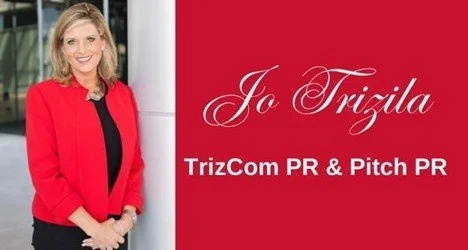
Jo Trizila – Founder & CEO of TrizCom PR
Jo Trizila is the founder and CEO of TrizCom PR, a leading Dallas-based public relations firm known for delivering strategic communications that drive business growth and enhance brand reputations as well as Pitch PR, a press release distribution agency. With over 25 years of experience in PR and marketing, Jo has helped countless organizations navigate complex communication challenges, ranging from crisis management to brand storytelling. Under her leadership, TrizCom PR has earned recognition for its results-driven approach, combining traditional and integrated digital strategies to deliver impactful, measurable outcomes for clients across various industries, including healthcare, technology and nonprofit sectors. Jo is passionate about helping businesses amplify their voices and connect with audiences meaningfully. Her hands-on approach and commitment to excellence have established TrizCom PR as a trusted partner for companies seeking to elevate their brand and achieve lasting success. Contact Jo at jo@TrizCom.com.
More AI FAQ
How does AI search affect public relations?
AI search changes PR because visibility is no longer limited to traditional media placement or Google rankings. AI tools pull from websites, earned media, press releases, executive bios, reviews and third-party sources to form answers. PR now has to shape not only what people read, but what AI systems understand and cite.
How can PR improve AI citations?
PR can improve AI citations by creating clear, consistent and credible public signals across earned media, executive commentary, bylined articles, podcasts, awards, reviews and third-party mentions. These signals help AI tools understand what a company does, who leads it and why it may be credible. PR does not replace SEO. It strengthens the source material AI tools may use when forming answers.
What is the difference between SEO and GEO?
SEO helps content rank and attract traffic through traditional search engines. GEO, or generative engine optimization, focuses on helping companies appear accurately in AI-generated answers, summaries and recommendations. For leaders, the practical difference is this: SEO helps people find your pages, while GEO helps AI tools understand, summarize and cite your company correctly.
How do earned media mentions affect AI search?
Earned media mentions can support AI search visibility when coverage is accurate, relevant and connected to the right company, leader or topic. Strong media mentions create third-party proof that owned content alone cannot provide. When media coverage reinforces the same company name, services, leadership and category language, it strengthens the signals AI tools may use.
How can a company monitor AI answers?
A company can monitor AI answers by regularly testing key prompts across ChatGPT, Gemini, Perplexity and Google’s AI features. Track whether the company appears, how it is described, which sources are cited, which competitors appear and what information is missing or wrong. AI visibility should be reviewed alongside organic impressions, referral traffic, earned media pickup and lead quality.
What should leaders fix before investing in AI search visibility?
Leaders should fix the foundation first: official company name, website clarity, executive bios, service descriptions, review profiles, earned media references and technical crawlability. If those basics are inconsistent across the website, press releases, profiles and media coverage, AI tools receive mixed signals. Fancy tactics come later. Fix the weak spots first.
How often should AI visibility be reviewed?
Companies should review AI visibility every 90 to 180 days. For fast-moving categories, major announcements, leadership changes, reputation issues or new service launches, review more often. AI search visibility is not a one-time audit because competitors publish, platforms change and old information can keep resurfacing.